Edufest 2026 · Future Me
Edufest Leadership Hackathon – School Safe Challenge 2026
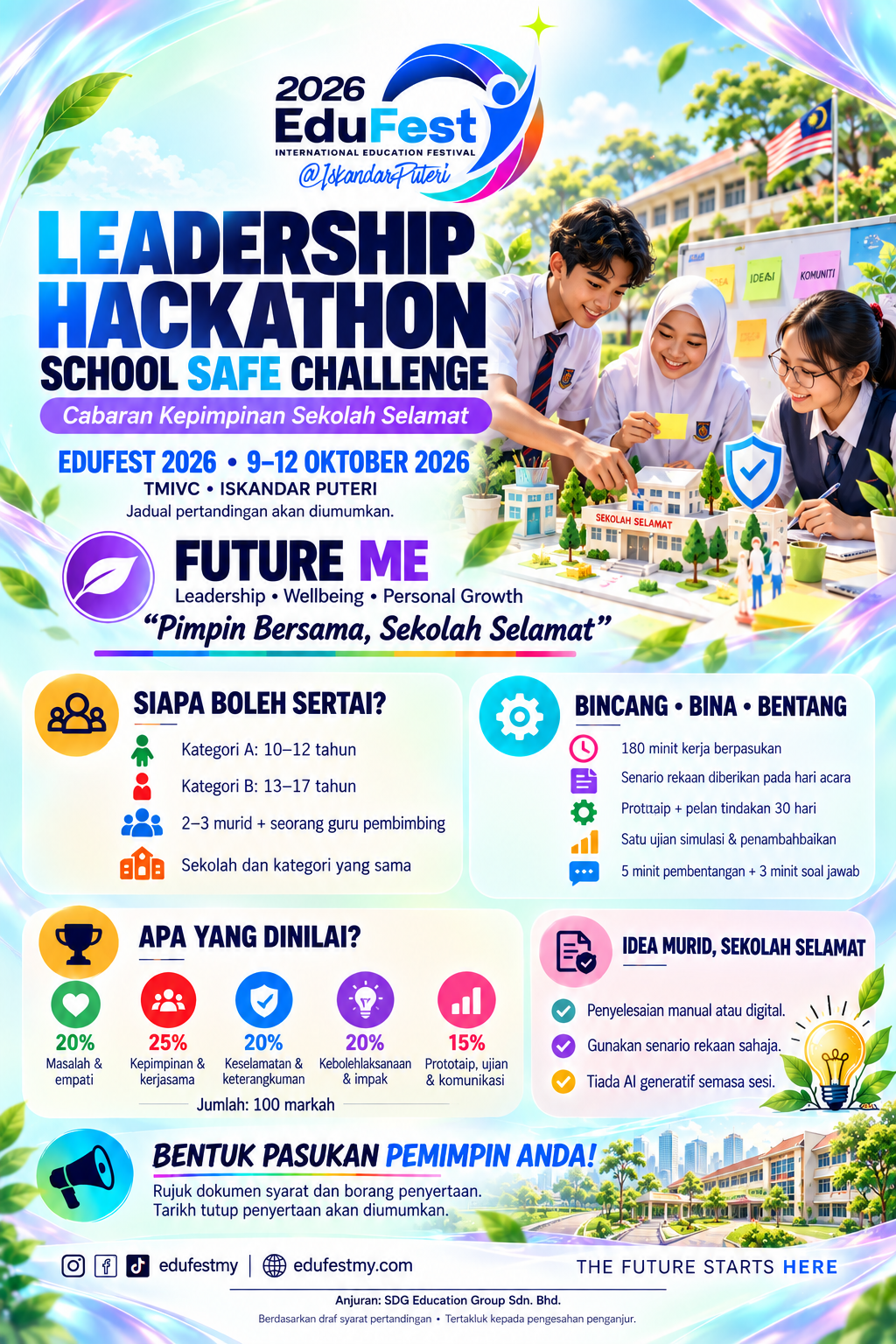
Teams of 2–3 students tackle a made-up school safety scenario, build a prototype and a 30-day action plan, and present their solution — a 180-minute leadership hackathon. Theme: Pimpin Bersama, Sekolah Selamat.
- Who
- Pupils aged 10–17 (Category A 10–12, Category B 13–17)
- Team
- 2–3 students + 1 advisor teacher
- Fee
- Free
- Organiser
- SDG Education Group Sdn. Bhd.
Categories
- Category A — Primary: age 10–12
- Category B — Secondary: age 13–17
Age is counted on 31 December 2026. Open to government, aided, private and international schools in Malaysia and abroad. Team entry: 2–3 students from the same school and category plus one advisor teacher. Each student joins only one team. Programming and computers are not required — manual and digital solutions are judged with the same rubric.
How to take part
1. Register for Edufest
The advisor teacher signs in with Google and registers the school contingent. Student entry is free.
2. Form a team
In the School Panel, select 2–3 students from the same school and age category for one Leadership Hackathon team entry.
3. Complete team details
Add each member's date of birth, class and role, guardian emergency contacts, access needs and the declarations.
4. Build on the day
Receive the made-up school safety scenario, work through the 180-minute hackathon (understand, ideate, build and test, finalise), then present for 5 minutes plus 3 minutes of Q&A.
Hackathon format
- Theme “Pimpin Bersama, Sekolah Selamat”: made-up scenarios may cover safety communication, peer wellbeing, bullying prevention, inclusive access or safe movement at school. Every team in a category receives the same scenario, facts and base materials on the day.
- 180 minutes of team work: 20 minutes understanding the problem, 40 minutes generating ideas, 80 minutes building and testing, and 40 minutes finalising the plan. Briefing and presentations are separate.
- Required outputs: a problem canvas, a prototype, a 30-day action plan (steps, owners, school approvals, resources, risks, success measures), a simulation test record with one improvement, and a member contribution log.
- Submission format: maximum 5 slides or 5 A4 pages plus the prototype — digital PDF up to 20 MB or paper, judged equally. No compulsory video or app development.
- Presentation: 5 minutes plus 3 minutes of Q&A. All members attend and contribute; a leader title earns no extra marks.
Judging criteria
Each criterion is scored 0–5 and scaled to its weight, for 100 marks in total; multiple judges are averaged and the final mark is rounded to two decimals. Ties compare leadership and teamwork, then safety and inclusivity, then feasibility. Material cost, digital sophistication, popularity or language polish alone earn no extra marks.
Originality, AI & wellbeing
- Ideas and final outputs are built during the session. General reference reading beforehand is fine, but finished projects or complete proposals from outside are not allowed.
- No generative AI during the session; internet is limited to organiser-approved sources, and outside help to obtain solutions is not allowed. AI used for general learning before the event may be declared, with no bonus or penalty.
- Use made-up names, locations and data only — never real identities, discipline records or personal experiences. No investigating schoolmates, testing school security, hacking, fake emergencies or frightening re-enactments.
- Participants may ask for a break or an equivalent alternative scenario if content causes discomfort; wellbeing officers handle support confidentially. Real concerns are referred to the designated teacher or safeguarding officer and never included in competition materials.
- Keep a decision and contribution log — judges assess teamwork through observation, outputs and answers, not loudness or one member dominating.
Awards
Champion, 1st Runner-up and 2nd Runner-up per category. Prize values and certificate eligibility to be confirmed by the organiser. Results appear on the Edufest results page and count toward school points and e-certificates.
The closing date and time, registration link, session dates and exact location, contact details, prize values, certificate eligibility and results date are pending official confirmation.