Edufest 2026 · Future Planet
Edufest Eco-Innovation Challenge 2026
“Inovasi Hijau, Impak Lestari”
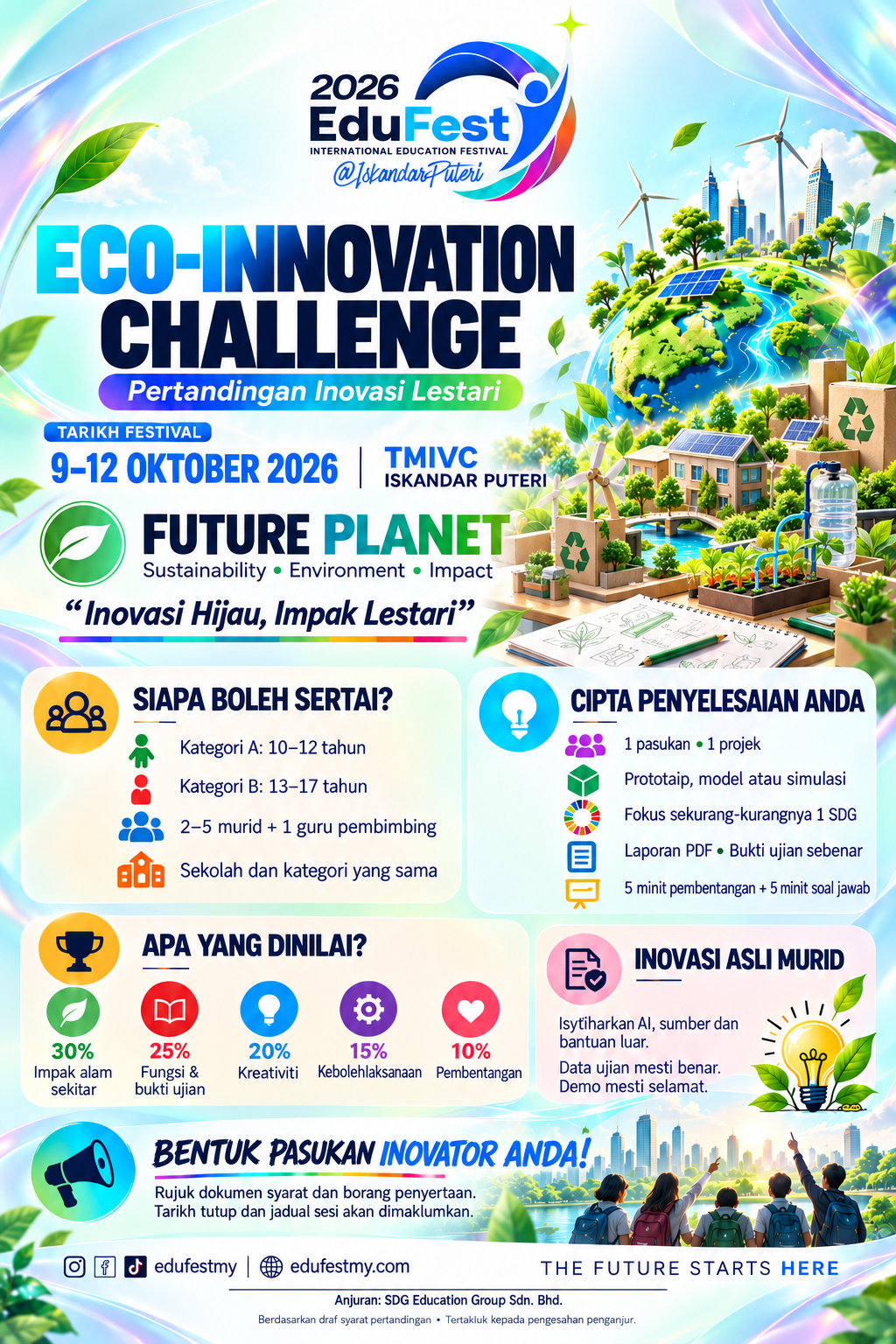
Under the theme “Inovasi Hijau, Impak Lestari”, teams identify a clear environmental problem linked to at least one SDG, then design, build and test a product, system or process with real evidence — compared against the existing situation — and present it to judges in 5 minutes plus 5 minutes of Q&A.
- Who
- Students aged 10–17 (Category A 10–12, Category B 13–17)
- Team
- 2–5 students + 1 advisor teacher
- Fee
- Free
- Organiser
- SDG Education Group Sdn. Bhd.
Categories
- Category A — Primary: age 10–12
- Category B — Secondary: age 13–17
Age is counted on 31 December 2026. Open to government, aided, private and international schools in Malaysia and abroad. Team entry: 2–5 students from the same school and category plus one advisor teacher. Each student joins only one team; each team submits one project. Schools may send more than one team.
How to take part
1. Register for Edufest
The advisor teacher signs in with Google and registers the school contingent. Student entry is free.
2. Form a team
In the School Panel, select 2–5 students from the same school and category for one Eco-Innovation team entry.
3. Build and test
Develop a prototype, model or simulation and test it against the existing situation, recording real data.
4. Submit and present
Submit the PDF report link, summary, test evidence and declarations, then present for 5 minutes plus 5 minutes of Q&A.
Technical specifications
- One prototype, demonstration model or simulation per team — an idea poster alone is not enough.
- Exhibit size up to 60 × 60 × 60 cm and 10 kg.
- PDF report up to 10 pages including appendices and 10 MB, with 3–5 clear photos of the prototype and development.
- Optional supporting video: up to 3 minutes, MP4, 200 MB.
- 5-minute presentation including demo, followed by 5 minutes of Q&A.
- Test evidence must compare against the original situation or an existing method, with data, units and limitations.
Judging criteria
Judged separately per category. High cost or sophisticated tools earn no automatic marks. Ties compare environmental impact, then function and test evidence, then creativity, followed by panel decision. Social media engagement does not count.
Key rules
- Address a clear environmental problem linked to at least one SDG — e.g. waste reduction, reuse, water or energy efficiency, sustainable farming, biodiversity or community solutions.
- Explain the problem, target users, existing solutions and your improvement. Separate real test results from estimates; do not claim unproven impact.
- Students produce the ideas, design, analysis and presentation. Teachers guide methodology and safety; expert help for risky work must be declared.
- AI may support ideation, language review or code, and must be declared. AI must not create test data, references, evidence photos or impact claims.
- Safety: no open flame, toxic or explosive materials, pressurised containers or microorganism cultures; electrics up to 12 V DC battery with protected terminals; no mains power without written approval; no live animals; treated water must not be shown as drinking water.
- Report in Bahasa Melayu or English; summary up to 150 words. File name: Category_SchoolName_TeamName_ProjectTitle.pdf. Keep links active until 30 days after results.
Awards
Champion, 1st Runner-up and 2nd Runner-up in each category. Results appear on the Edufest results page and count toward school points and e-certificates.
The closing date and time, registration link, presentation schedule and selection method, prototype delivery instructions, contact details, prize values, certificate eligibility, results date and exhibition arrangements are pending official confirmation.