Edufest 2026 · Future Tech
Edufest Apps & Games Creation Challenge 2026
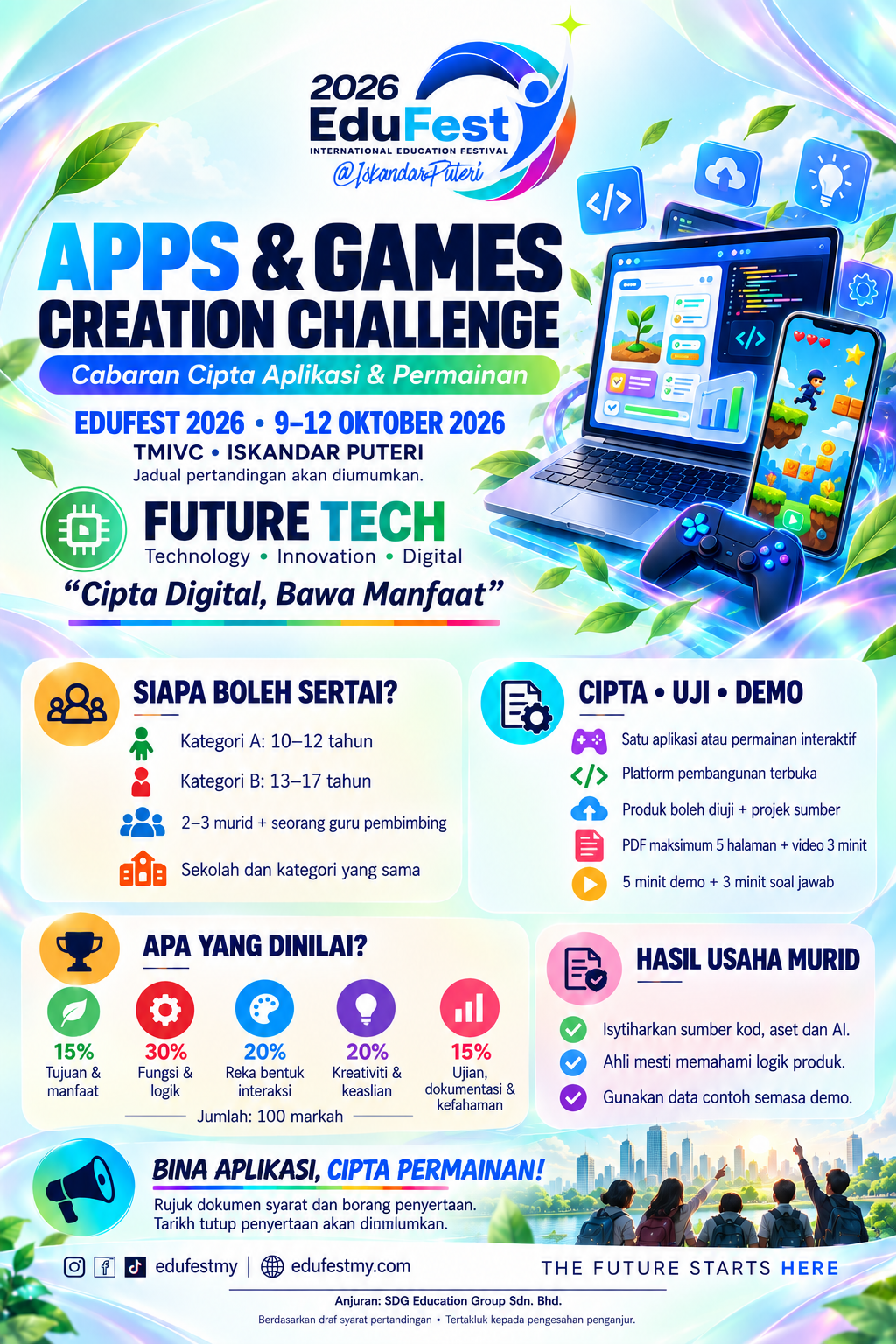
- Who
- Pupils aged 10–17 (Category A 10–12, Category B 13–17)
- Team
- 2–3 students + 1 advisor teacher
- Fee
- Free
- Organiser
- SDG Education Group Sdn. Bhd.
Categories
- Category A — Primary: age 10–12
- Category B — Secondary: age 13–17
Age is counted on 31 December 2026. Open to government, aided, private and international schools in Malaysia and abroad. Team entry: 2–3 students from the same school and category plus one advisor teacher. Each student joins only one team; each team submits one app or game. Apps and games share the same rubric and are not separate prize categories.
How to take part
1. Register for Edufest
The advisor teacher signs in with Google and registers the school contingent. Student entry is free.
2. Form a team
In the School Panel, select 2–3 students from the same school and age category for one Apps & Games team entry.
3. Build and test before the event
Create one interactive app or game, test it with users and prepare the PDF and demo video.
4. Submit and demo
Submit the product, source, PDF and video links with the declarations, then demo for 5 minutes plus 3 minutes of Q&A.
Product & submission specifications
- Theme “Cipta Digital, Bawa Manfaat”: apps solve a user problem; games have a clear objective and playing or learning experience. Topics may cover education, community, environment or wellbeing.
- Built before the event with at least one working interactive flow — slides or static screens alone are not enough.
- Open platform: web, mobile, desktop, visual blocks or no-code. State the version, device needs and how to run it.
- Submit a testable product link or build, an editable source project or equivalent editor access, a PDF of up to 5 pages and a demo video of up to 3 minutes.
- Limits: 200 MB for the project archive and documents, 100 MB for the MP4 video. List external dependencies separately; never include personal passwords or API keys.
- Demo: 5 minutes plus 3 minutes of Q&A. All members attend, contribute and understand the main logic.
Judging criteria
Each criterion is scored 0–5 and scaled to its weight, for 100 marks in total; multiple judges are averaged and rounded to two decimals. Ties compare function and logic, then interaction design, then creativity and originality. Platform price, downloads and social media popularity earn no marks.
Originality, AI & privacy
- The idea, flow and main development are done by the team. Templates or tutorials only renamed, recoloured or re-skinned are not original work.
- Third-party code, libraries, music, images and fonts are allowed under their licences — declare the source, licence, part used and changes.
- AI may help with ideas, code, assets or debugging if declared; members must understand, test and explain AI-assisted parts. If AI is a product feature, state the model or service, limits, cost and internet needs, and provide a demo mode with sample data.
- Keep project versions, flow sketches, process screenshots and test evidence. Judges may ask members to explain logic or change a simple feature.
- Use sample data only. No malicious code, hidden data collection, intrusive ads, required purchases, real-money gambling, exploitation or hateful content. Judges never need a personal account or payment.
Awards
Champion, 1st Runner-up and 2nd Runner-up per category. Prize values and certificate eligibility to be confirmed by the organiser. Results appear on the Edufest results page and count toward school points and e-certificates.
The closing date and time, registration link, competition schedule, contact details, prize values, certificate eligibility and results date are pending official confirmation.