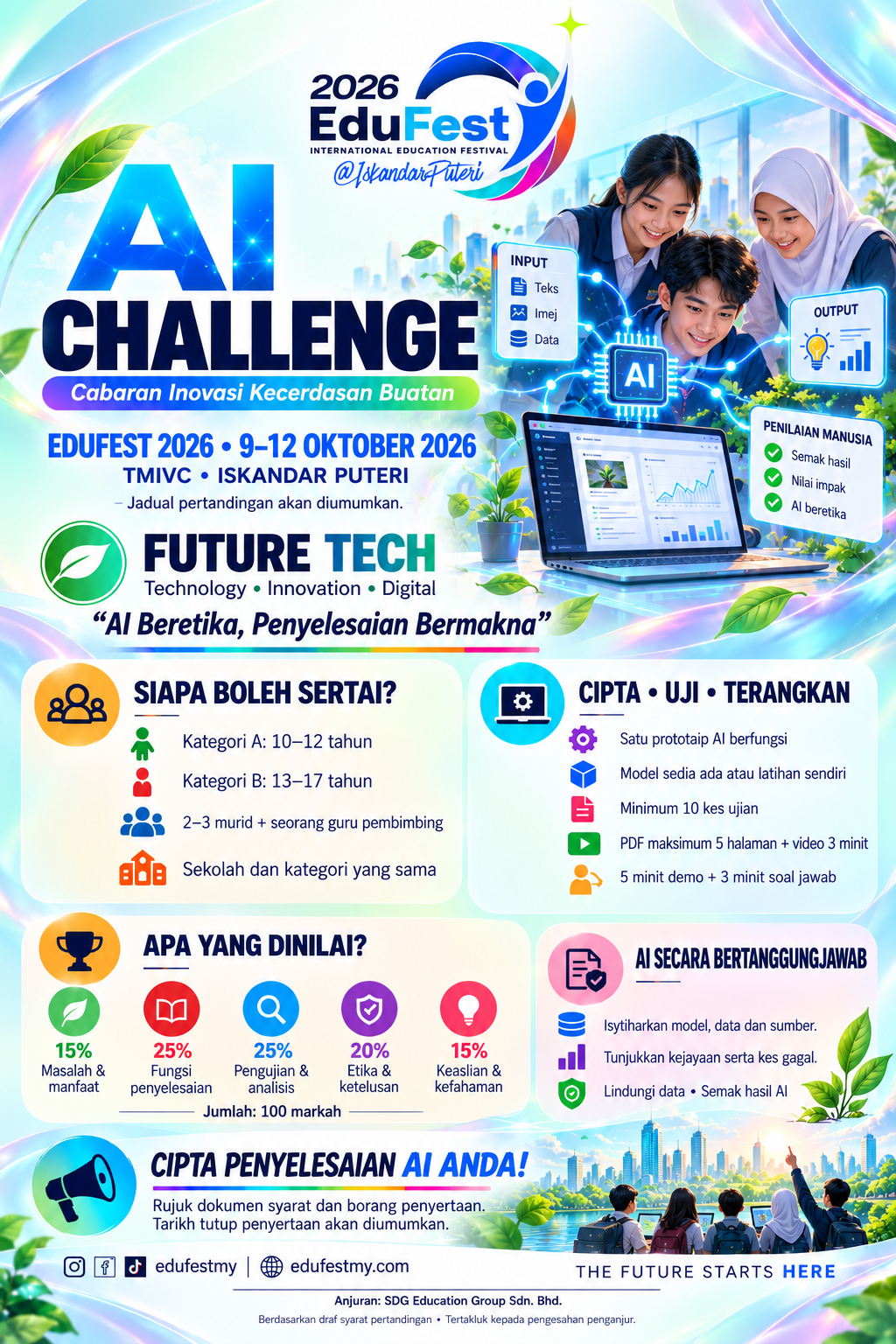
- Who
- Pupils aged 10–17 (Category A 10–12, Category B 13–17)
- Team
- 2–3 students + 1 advisor teacher
- Fee
- Free
- Organiser
- SDG Education Group Sdn. Bhd.
Categories
- Category A — Primary: age 10–12
- Category B — Secondary: age 13–17
Age is counted on 31 December 2026. Open to government, aided, private and international schools in Malaysia and abroad. Team entry: 2–3 students from the same school and category plus one advisor teacher. Each student joins only one team; each team submits one AI project. Paid platforms or training your own model are not required.
How to take part
1. Register for Edufest
The advisor teacher signs in with Google and registers the school contingent. Student entry is free.
2. Form a team
In the School Panel, select 2–3 students from the same school and age category for one AI Challenge team entry.
3. Build and test before the event
Build a working AI prototype, record at least 10 test cases including failures, and prepare the PDF and demo video.
4. Submit and demo
Submit the prototype, project, test record, PDF and video links with the declarations, then demo for 5 minutes plus 3 minutes of Q&A.
Project & test evidence
- Theme “AI Beretika, Penyelesaian Bermakna”: explain the problem, target users and why AI suits it. Examples include sorting materials, learning aids or guided information search.
- AI must be a working, demonstrable component — slides, concept videos or a single AI output without a solution flow and testing are not enough.
- Existing models, visual machine learning, generative AI or no-code tools are allowed. Training your own model is optional and earns no automatic bonus.
- Submit a testable prototype, project files or editor access, a PDF of up to 5 pages and an MP4 video of up to 3 minutes (archive 200 MB, video 100 MB).
- Include at least 10 documented test cases with input, expected result, actual result and outcome — covering normal cases, out-of-scope inputs and failures.
- Demo: 5 minutes plus 3 minutes of Q&A, showing a full flow, a success, a failure and how a person checks or corrects the result.
Judging criteria
Each criterion is scored 0–5 and scaled to its weight, for 100 marks in total; multiple judges are averaged and rounded to two decimals. Ties compare testing and analysis, then solution function, then ethics and transparency. An advanced model does not guarantee high marks.
Responsible AI
- Declare models, libraries, datasets, code, key prompts and assets with their sources and licences. Base models may not be claimed as the team's creation.
- Separate AI as a product component from AI that helped development, and keep versions, prompts, settings and sample outputs.
- If training a model, keep training and test data separate. Accuracy claims must state test size and method.
- Use made-up, suitable open or permitted data only — no personal, biometric or confidential pupil data. State possible bias, factual errors and untested situations.
- No misleading impersonation, unconsented surveillance or high-impact decisions about individuals. Generative AI needs human oversight and a way to refuse out-of-scope input. No passwords or API keys in files.
Awards
Champion, 1st Runner-up and 2nd Runner-up per category. Prize values and certificate eligibility to be confirmed by the organiser. Results appear on the Edufest results page and count toward school points and e-certificates.
The closing date and time, registration link, session dates and exact location, demo schedule, contact details, prize values, certificate eligibility and results date are pending official confirmation.