Edufest 2026 · Future Tech
Edufest 3D Printing Creation Challenge 2026
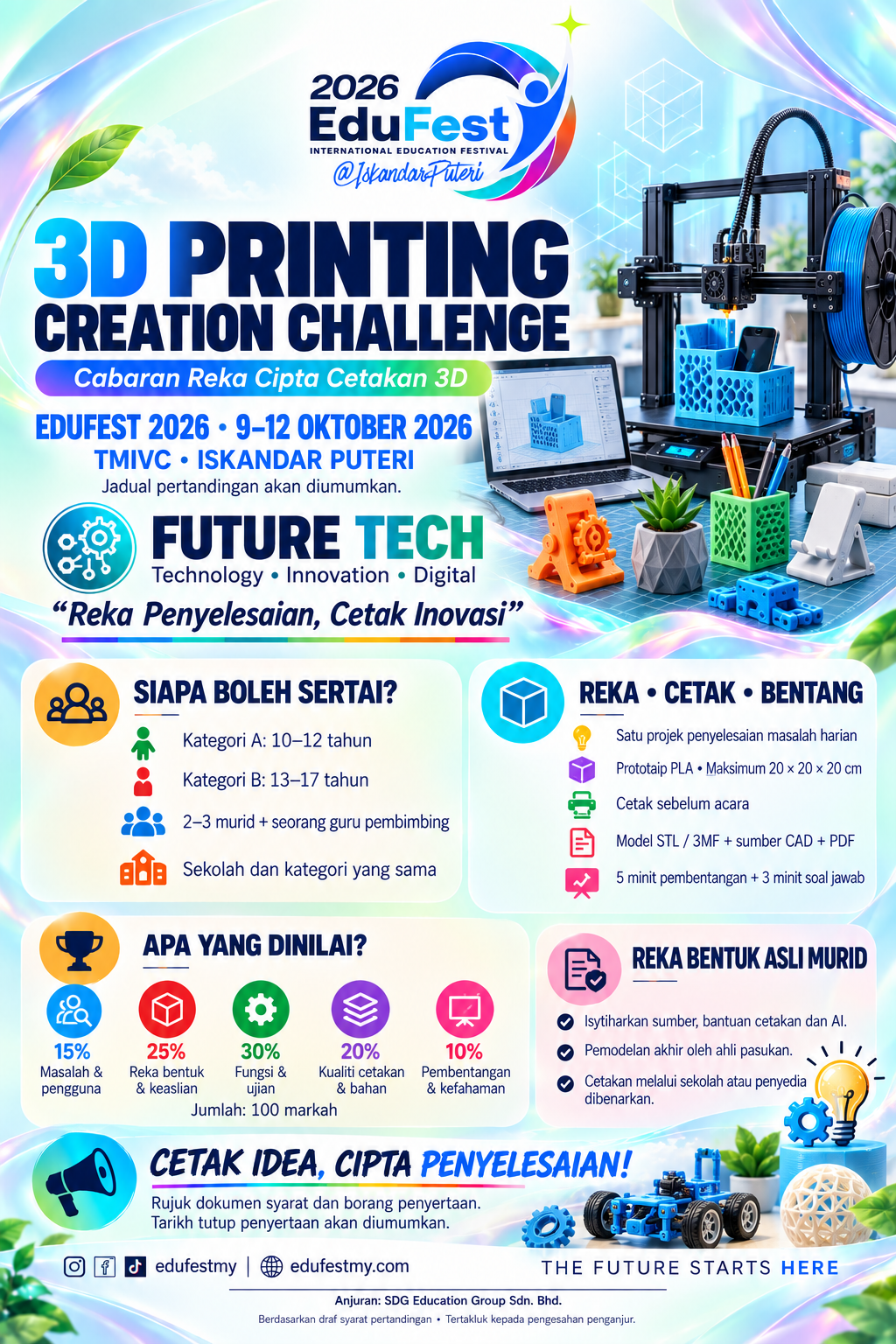
Theme: "Reka Penyelesaian, Cetak Inovasi". Teams of 2–3 students from the same school and category, with one advisor teacher, identify an everyday problem at school, home or in the community and produce a 3D-printed solution. FDM/FFF printing in PLA, completed before the event; the assembled prototype must fit within 20 × 20 × 20 cm. Submissions include an STL/3MF model (millimetre units), an editable CAD source and a PDF of up to 5 pages; total maximum 50 MB. Presentation: 5 minutes plus 3 minutes of Q&A.
- Who
- Students aged 10–17 (Category A: 10–12, Category B: 13–17, age on 31 December 2026)
- Team
- 2–3 students + 1 advisor teacher
- Fee
- Free
- Organiser
- SDG Education Group Sdn. Bhd.
Categories
- Category A — Primary: age 10–12
- Category B — Secondary: age 13–17
Age is counted on 31 December 2026. Open to government, aided, private and international schools in Malaysia and abroad. Team entry: 2–3 students from the same school and category plus one advisor teacher. Each student joins only one team; each team submits one project. Schools may send more than one team.
How to take part
1. Register for Edufest
The advisor teacher signs in with Google and registers the school contingent. Student entry is free.
2. Form a team
In the School Panel, select 2–3 students from the same school and age category for one 3D Printing team entry.
3. Design and print before the event
Model the solution in CAD, print it in PLA through your school, lab or a declared provider, and prepare the PDF documentation.
4. Submit and present
Submit the STL/3MF, CAD source and PDF links with the declarations, then present for 5 minutes plus 3 minutes of Q&A.
Model & prototype specifications
- One project per team: a digital model, a physical prototype and matching documentation solving an everyday problem at school, home or in the community.
- FDM/FFF printing in PLA, completed before the event — no live printing session is required. Parts may be printed separately and assembled.
- The assembled prototype must fit within 20 × 20 × 20 cm.
- Files: STL or 3MF in millimetre units, an editable CAD source or equivalent export, and a PDF of up to 5 pages including test evidence. Total maximum 50 MB. G-code is not required.
- Simple support components such as screws, cord or enclosed magnets are allowed if declared; printed parts must be the main functional element.
- Presentation: 5 minutes of explanation plus 3 minutes of Q&A. All members attend and contribute.
Judging criteria
Each criterion is scored 0–5 and scaled to its weight, for 100 marks in total; multiple judges are averaged. Judged separately per category. Ties compare function and testing, then design and originality, then print quality. Printer price, software brand and social media popularity earn no marks.
Originality, AI & safety
- The main model must be designed by the team. Downloaded models that are only resized, recoloured or renamed are not original work. Open components and references are allowed under their licences with declaration.
- AI may help ideation, learning or language checks with declaration. AI-generated 3D models may not be submitted as the students' design; final modelling is done by the team.
- Keep sketches, CAD versions, process screenshots and test evidence for verification. Declare who printed the parts and any technical or finishing help; adults may operate the printer but may not design for the team.
- Paint, light sanding and assembly are allowed with suitable supervision and declaration. Finishing must not hide function failures or replace the main printed parts.
- Safety: adult supervision for printing and hot parts, suitable ventilation, no touching hot nozzles or beds, and no unsupervised sharp tools. Prototypes must be clean, stable and free of sharp edges. Weapons, weapon replicas, dangerous objects, offensive content and risky demonstrations are not accepted.
- Projects are not tested on people or animals, and no medical, structural-safety or food-contact claims may be made without relevant certification.
Awards
Prize values and certificate eligibility to be confirmed by the organiser. Results appear on the Edufest results page and count toward school points and e-certificates.
The closing date and time, registration link, presentation schedule, prototype delivery instructions, contact details, prize values, certificate eligibility, results date and exhibition arrangements are pending official confirmation.